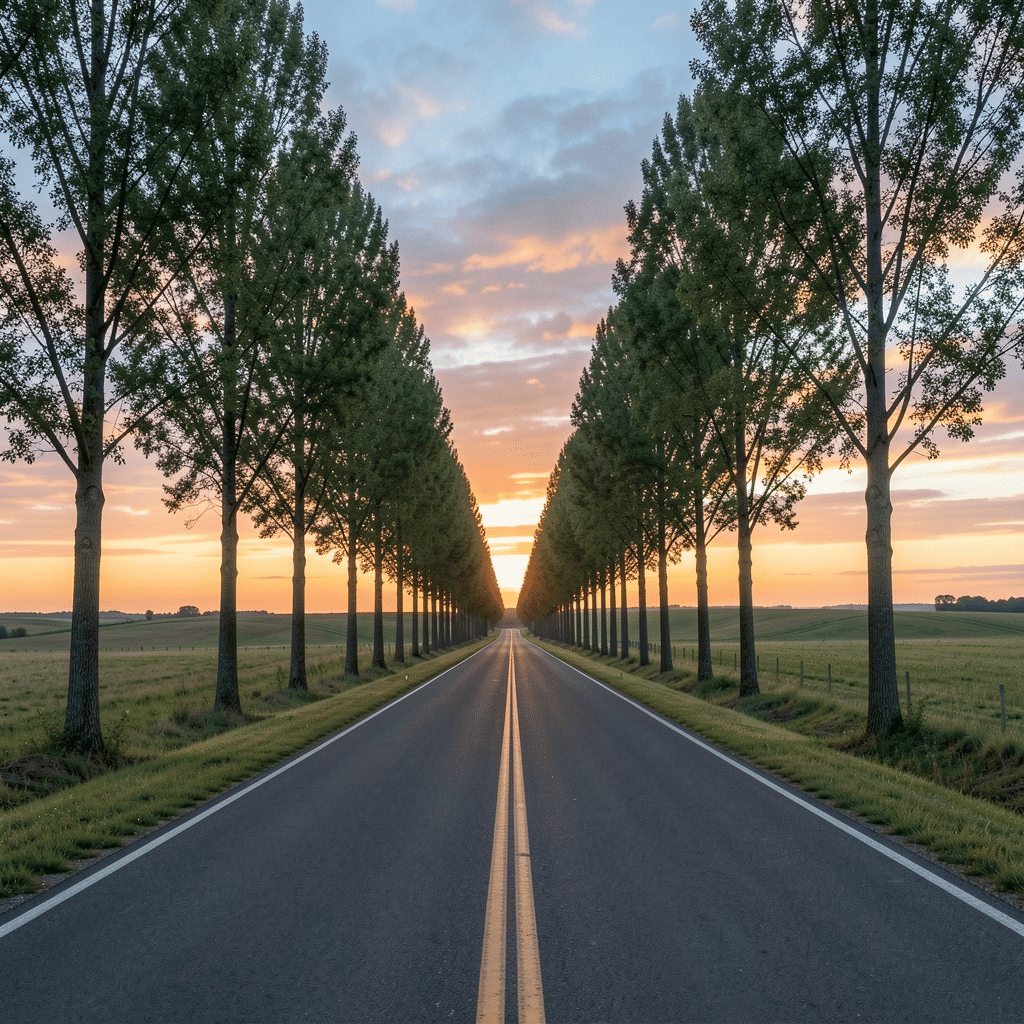
In the vast world of visual art, creating compelling images often hinges upon one’s ability to guide the viewers’ eyes. One effective technique to achieve this is the use of leading lines. These are elements within the composition that naturally attract the viewer’s gaze and take them on a journey through the image.
Leading lines can be found both in nature and urban settings, spanning roads that stretch towards the horizon, rivers bending through valleys, and architectural elements like bridges or staircases. They serve as visual pathways that captivate interest and draw attention to the focal point of the image, adding depth and perspective.
Natural lines are abundant in landscapes. Think about the lines created by shores, mountain ridges, or rows of trees. These elements are organic and can be harnessed creatively to build a narrative or emphasize the grandeur of a scene. For instance, a winding path through a forest guides the viewer not just through the photograph but into an imaginary stroll through the woods.
Man-made lines, on the other hand, offer precision and structure. Urban environments are especially rich with these opportunities. Streets, railways, and fences provide straight or curved alignments that can lead directly to the subject. A skilled capture of such lines can imbue a scene with a sense of dynamism or tranquility, depending on the context and the lines' arrangement.
Lighting and perspective play crucial roles in enhancing the effect of leading lines. The interplay of light and shadow can accentuate these lines, while choosing a vantage point that maximizes their length or direction can lend greater impact. Shooting from a lower angle, for instance, might emphasize a road that converges towards the skyline, thereby portraying a sense of limitless adventure.
Incorporating leading lines into your compositions demands a keen eye and patience. Observing your surroundings to identify potential lines requires both an understanding of the environment and an imaginative approach to seeing beyond the obvious. Experimentation is key. Try different angles, times of day, and weather conditions to find the perfect combination that utilizes leading lines effectively.
In conclusion, leading lines are a powerful compositional element in visual storytelling. Whether through the natural world or urban architecture, these lines offer an opportunity to direct the viewer’s journey through your image. By understanding and effectively incorporating these elements, one can transform ordinary scenes into extraordinary experiences, creating images that not only capture attention but also evoke emotion and curiosity.